AI Candidate Sourcing.
ALLPS AI is an AI-native recruitment platform built around TARA, its AI interview agent, and an intelligent ATS at its core. Recruiters using the platform could screen, interview, and track candidates — but sourcing them in the first place still happened elsewhere. LinkedIn searches, manual Boolean queries, tab-switching between job boards, copy-pasting profiles into the ATS — the front end of the hiring funnel was entirely disconnected from the rest of the workflow. This project designed and integrated an AI Sourcing module directly into the ALLPS AI platform, closing that gap and making candidate discovery a native, intelligent part of the recruiter's existing environment.
Client

Year
2023
Industry
Hiring & Recruitment
Role
Product Designer
Challenge
The missing sourcing layer created three compounding issues. Operationally, recruiters were context-switching constantly — leaving the ATS to search job boards, manually evaluating profiles against job requirements, and re-entering candidate data back into the system. Every step was manual, every transition was friction. From a quality standpoint, traditional sourcing tools return results based on keyword matching — a recruiter searching for "Senior DevOps Engineer" gets everyone with those words on their profile, with no intelligence applied to how well any of them actually fit the role. And from a compliance standpoint, scraping and storing candidate data across platforms without a clear consent and notification mechanism exposed recruiters to GDPR risk that most weren't actively managing. The sourcing process was broken at every stage — speed, quality, and legality.
approach
Mapped the existing recruiter workflow end-to-end before designing a single screen — understanding exactly where sourcing sat in the process and what information recruiters needed at each decision point
Identified three distinct stages where design decisions mattered most: query input (how recruiters express what they're looking for), results evaluation (how they assess candidates quickly without full profiles), and profile depth (what they need before committing a credit to unlock)
Designed the search experience around natural language rather than Boolean filters — removing the technical barrier that excludes non-specialist recruiters while still producing precise, high-quality results
Built the anonymisation-first model from the ground up, treating GDPR compliance not as a disclaimer at the bottom of the page but as a core interaction layer woven into every touchpoint where candidate data changes hands
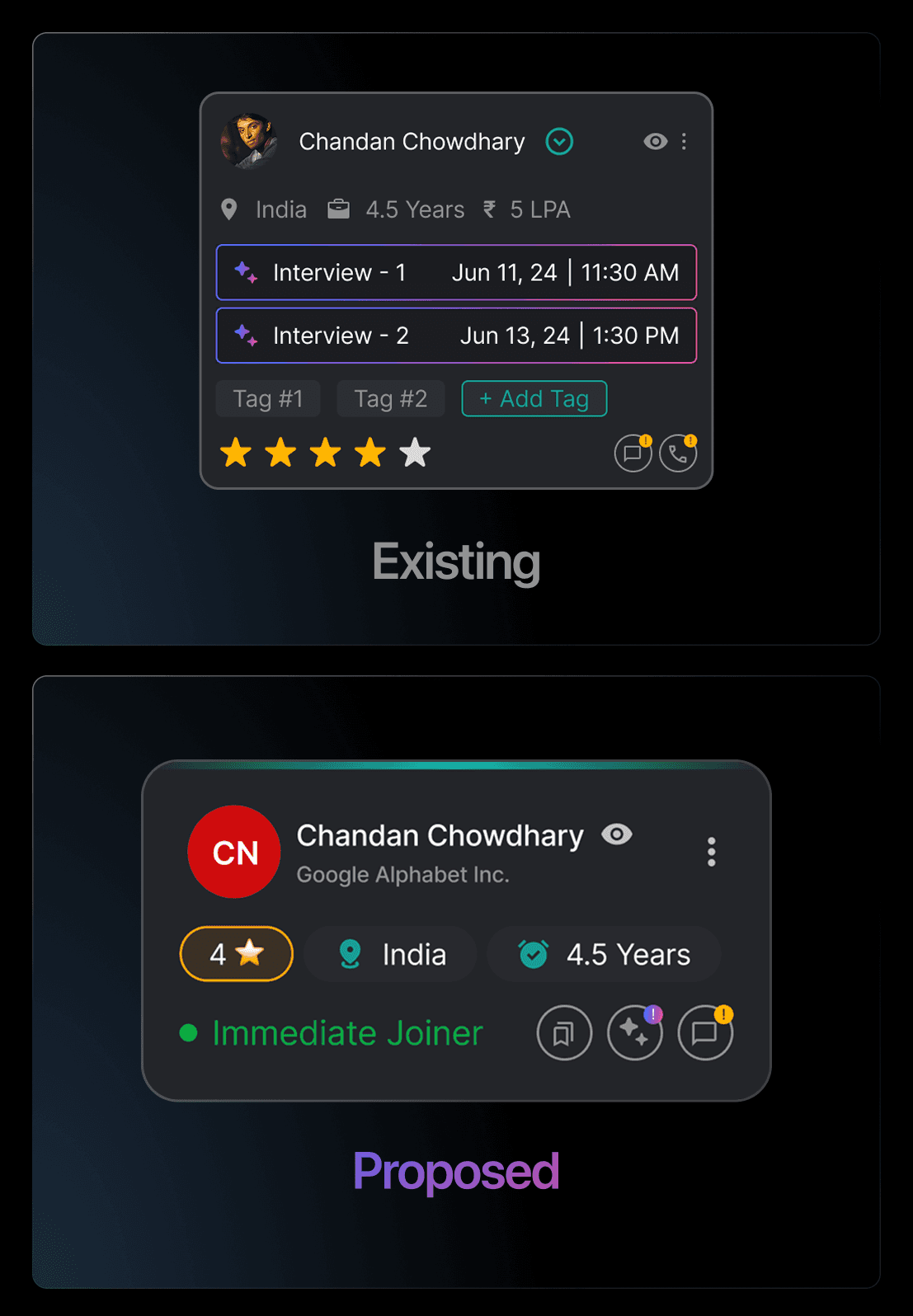
Kept the module visually and structurally consistent with the existing ALLPS AI design language — dark surfaces, the established nav structure, the same component patterns — so the addition felt like a natural extension rather than a bolted-on feature
Low-Fidelity Prototyping using Claude & Vercel
key decisions
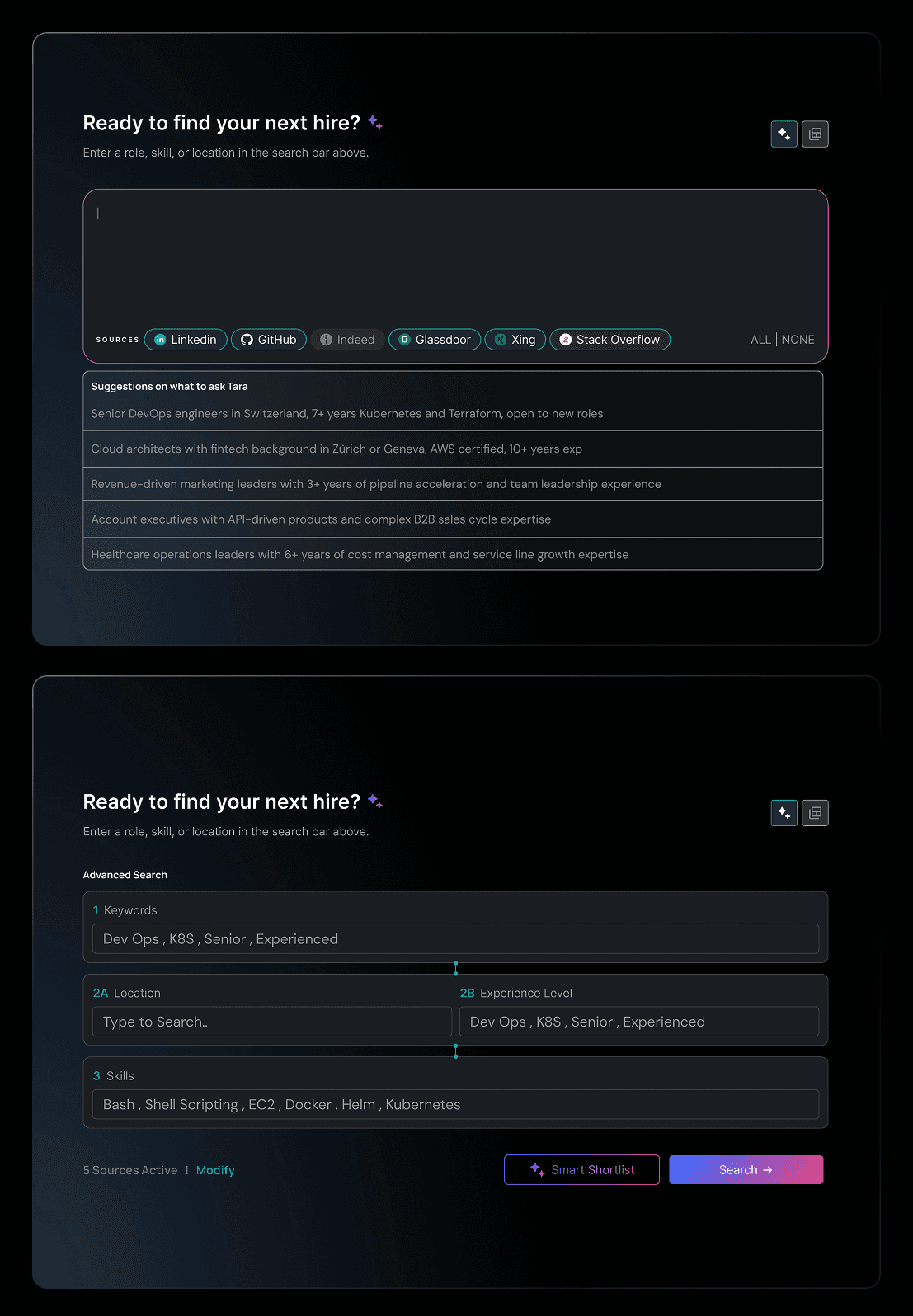
Natural language as the search primitive. The old way of sourcing candidates required recruiters to construct Boolean search strings — a technical skill most don't have and shouldn't need. The AI Sourcing module replaces this with a freeform natural language input: a recruiter types "Senior DevOps engineers in Switzerland, 7+ years Kubernetes and Terraform, open to new roles" and the AI interprets intent, not just keywords. TARA's suggested queries — surfaced directly below the input field — also serve as onboarding in disguise, showing less experienced recruiters what a well-formed sourcing prompt looks like without a tutorial in sight.
Multi-source aggregation with source transparency. Rather than locking sourcing to a single job board, the module pulls from LinkedIn, GitHub, Indeed, Glassdoor, Xing, and Stack Overflow simultaneously — with source toggles visible at the point of search so recruiters can include or exclude platforms based on the role. A developer role might weight GitHub and Stack Overflow heavily; a sales role might favour LinkedIn exclusively. The sources are surfaced on every result card and in the search summary bar, so recruiters always know where a profile came from.
Match scores as a filtering language, not just a ranking. Every candidate card surfaces an AI-generated match percentage — colour-coded from green at the high end to red at the low end — alongside a minimum score slider in the refine panel. This turns match quality into an active filter rather than a passive label. A recruiter can raise the threshold and collapse the results to only the strongest fits, or lower it and expand the pool. The score is the interface.
Anonymisation as the default, not the exception. All profiles are anonymised until unlocked — names, contact details, employer, LinkedIn URL, and professional summary are hidden behind a credit gate. This isn't a dark pattern; it's a deliberate privacy architecture. Recruiters can evaluate fit on skills, experience, location, and AI match score before spending a credit, which means they only unlock profiles they genuinely intend to pursue. The unlock modal reinforces this with a GDPR confirmation checkbox — "I confirm legitimate recruitment purpose. Candidate will be notified automatically." — making compliance an active step rather than a buried terms-of-service clause.
AI Insights as a decision-support layer, not a replacement for judgment. The candidate preview drawer includes an AI Insights tab that breaks the match score into its constituent dimensions — Skills Alignment, Experience Level, Location Fit, Industry Background, and Education — each with its own scored bar and a plain-language suitability summary at the top. A recruiter looking at a 96% match candidate can immediately see that the score is driven by near-perfect skills alignment and education, while location fit is lower — a nuance the headline score alone would never communicate. The AI explains its reasoning; the recruiter makes the call.
deliverables
Wireframes across all sourcing flows (search, results, preview, unlock)
Extension of the existing ALLPS AI design system with new components, patterns, and interaction states
Natural language search interface with AI-suggested query prompts
Candidate results grid with card and list view variants
Refine and filter panel components
Candidate preview drawer with tabbed navigation
New modal designs (unlock confirmation, GDPR consent, bulk unlock)
AI Insights dimensional scoring interface
Annotated design handoff assets for developer implementation
High-fidelity prototype showcasing the AI Sourcing functionality at a high level
impact
Closed the sourcing gap in ALLPS AI's recruitment workflow — candidate discovery is now a native part of the platform rather than a disconnected external process
Removed Boolean search complexity entirely, making high-quality sourcing accessible to recruiters of any technical level through natural language input
Built GDPR compliance directly into the unlock interaction, turning a legal obligation into a product feature that builds candidate trust and protects recruiter accountability
Delivered an AI Insights layer that makes match scores legible and actionable, giving recruiters the dimensional breakdown needed to make confident unlock decisions
reflections
The open question is whether the credit-per-unlock model creates the right incentive structure or inadvertently introduces friction that slows recruiter adoption. A pay-per-profile gate encourages quality over quantity — recruiters think before they unlock — but it also adds a decision cost to every candidate they want to pursue fully. I'd track unlock rates relative to search volume post-launch and watch for signs that recruiters are stopping at the preview stage more than they should. If drop-off at the unlock step is higher than expected, the next iteration should look at whether the AI Insights tab is providing enough confidence to justify the credit spend — or whether the anonymised preview needs to surface one more signal to push recruiters over the line.
More work
2020 - 2026
More of my work across SaaS, AI, and startups.