All-in-one AI Fleet Management.
Motive is an AI-powered integrated operations platform for the physical economy — combining driver safety, fleet management, equipment monitoring, spend management, and workforce management into a single product suite used by some of the most complex operations in the world. The existing website communicated scale through static imagery: dashboards frozen in screenshots, product features explained through flat graphics, and a visual language that described the product rather than demonstrated it. This project refreshed the brand's web presence and introduced a motion design system that lets the product speak for itself.
Client

Year
2025
Industry
Fleet Management
Role
UI & Motion Designer
Challenge
The old site had three compounding issues. Visually, it leaned heavily on static product screenshots and stock-style imagery — a passive approach that asked visitors to imagine the product in motion rather than showing them. For a platform whose core value proposition is real-time visibility and AI-powered automation, static imagery actively undermined the message. Structurally, a platform with six distinct product pillars and eleven industry verticals is inherently complex to communicate — without motion to guide attention and sequence information, sections felt dense and hard to parse quickly. And from a brand standpoint, the static treatment made Motive look comparable to every other enterprise SaaS tool in the fleet management space, when the product's actual capabilities warranted something significantly more confident and kinetic.
approach
Audited the existing site for every instance where static imagery was being asked to carry a message that motion could communicate more effectively — product demos, data visualisations, AI capability explanations, and real-time visibility sequences
Identified the hero as the highest-stakes design decision on the page and prioritised it first — a platform selling AI-powered real-time operations needed to open with something that moved
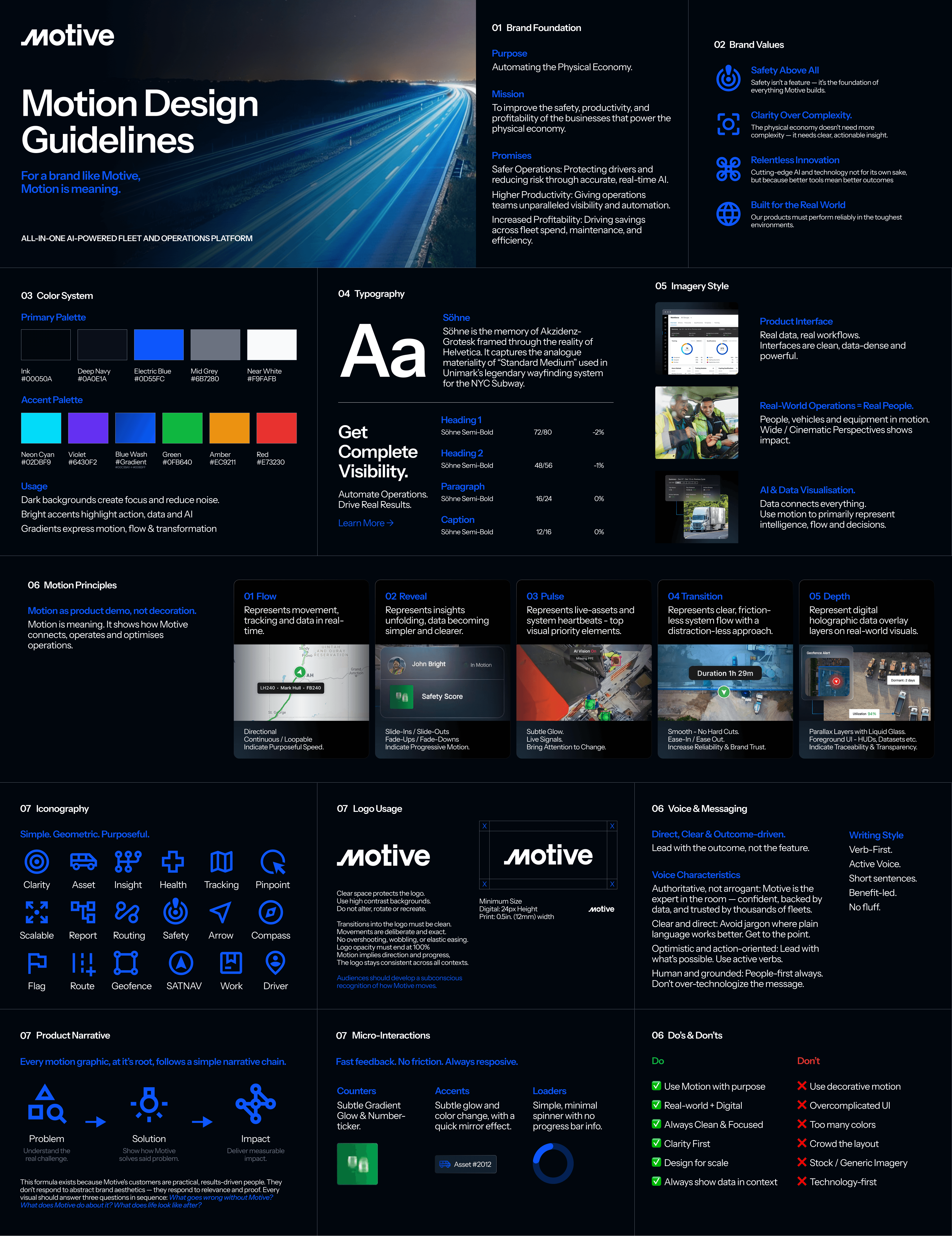
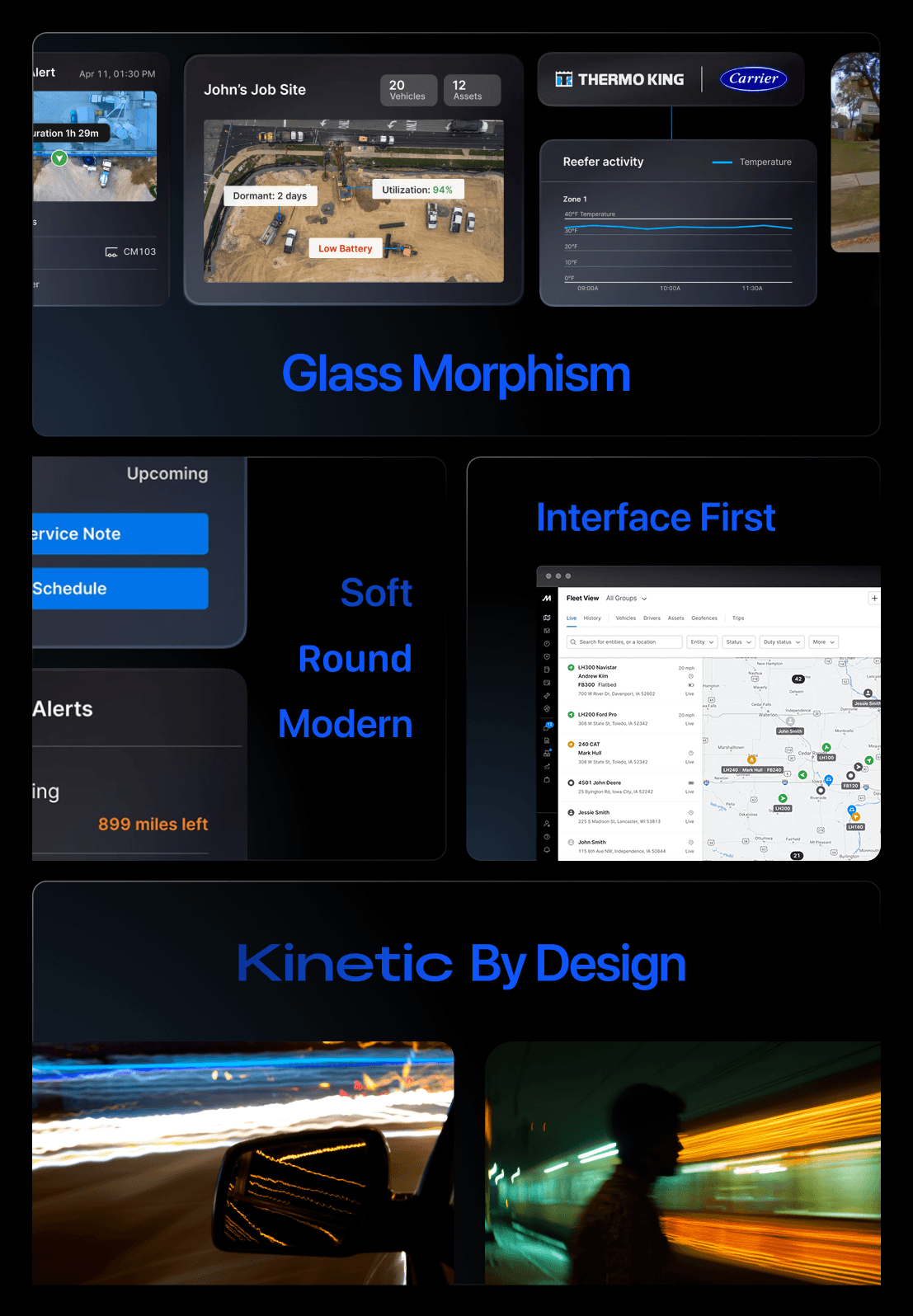
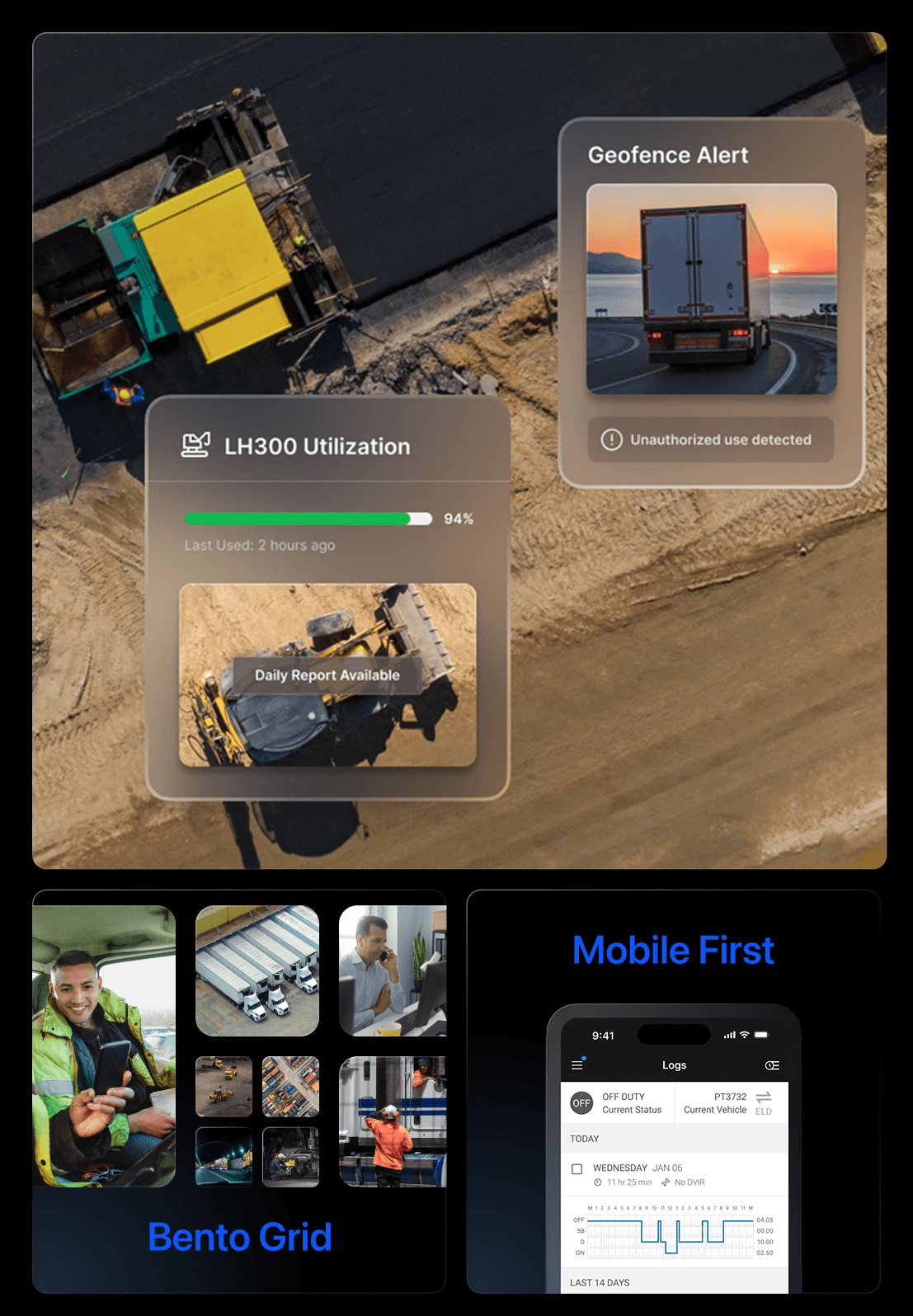
Developed a motion language rooted in the product's own visual vocabulary — the same data flows, alert animations, and map movements that exist inside the Motive platform, translated into web-native motion
Established timing, easing, and sequencing principles that could be applied consistently across all six product pillars, ensuring the motion system scaled without becoming inconsistent
Collaborated closely with developers throughout, defining motion specs precisely enough that implementation matched design intent without requiring repeated revision cycles
key decisions
Motion as product demo, not decoration. The most important shift in the redesign was treating animation as a functional communication layer rather than a visual flourish. The hero video doesn't show abstract kinetic graphics — it shows the Motive platform operating: dashboards updating in real time, AI flagging driver risk events, fleet positions moving across a live map. A visitor understands what the product does by watching ten seconds of the homepage, without reading a word.
Product complexity sequenced through scroll. Six product pillars presented simultaneously creates cognitive overload. The redesign uses scroll-triggered motion to introduce each product area one at a time — as the user scrolls, the platform view transitions between Driver Safety, Fleet Management, Equipment Monitoring, and so on, with each section animating in with enough weight to feel distinct. Scroll becomes the navigation; the page tells a sequential story instead of dumping everything at once.
Consistency across a sprawling product surface. A platform serving eleven different industries with six product lines and dozens of individual features risks becoming visually incoherent at scale. The motion system was designed with this in mind — shared easing curves, consistent animation durations, and a small set of entry and exit patterns that apply universally. Any new page or feature section built after the redesign can use the same motion primitives and feel like it belongs.
Brand confidence through kinetic identity. The static site looked like it was describing a powerful product. The redesigned site looks like it is one. Motion at the scale and fidelity used here — particularly in the hero and the integrated platform section — signals a level of product maturity and brand investment that static imagery simply cannot. For enterprise buyers evaluating fleet management platforms, perceived credibility is part of the decision.
deliverables
Brand identity refresh (colour, typography, visual language updates)
Motion design system (storyboarding, timing, easing, sequencing principles)
Hero video and animated platform sequence
Scroll-triggered product section animations
Component-level motion specs for developer handoff
Campaign asset motion templates
Design system documentation
A brief showcase of Motive's motion design system
impact
Replaced a static, passive web presence with a kinetic brand experience that demonstrates the product's real-time capabilities directly on the homepage
Established a motion design system that scales consistently across six product pillars, eleven industry verticals, and ongoing campaign work
Elevated Motive's visual positioning relative to competitors in the fleet management space — moving from descriptive to demonstrative
Delivered motion specifications precise enough for clean developer handoff, reducing implementation back-and-forth significantly
reflections
The open question with a motion-heavy redesign is always performance versus experience — particularly for enterprise visitors on variable network conditions or older hardware. I'd track Core Web Vitals closely post-launch, specifically LCP and CLS on the hero section, and maintain a fallback static treatment for visitors where motion degrades the experience rather than enhancing it. The design system was built to accommodate this: motion is layered on top of a solid static layout, so degrading gracefully doesn't require a structural rethink.
More work
2020 - 2026
More of my work across SaaS, AI, and startups.